The phrase “plan for the weather” used to mean little more than checking the forecast, moving the garden furniture, and deciding if the barbecue was a realistic ambition. It was a conversation about how long the washing would take to dry, whether it was T-shirt weather or coat weather. Something to work around, not something to design around.
That assumption was built into many of the places we know today. The weather was always there, of course, just rarely part of the design brief. Most Victorian high streets were created with soot, drizzle and the occasional street urchin in mind, not for the climate the Met Office is now describing as the country’s “new normal.”
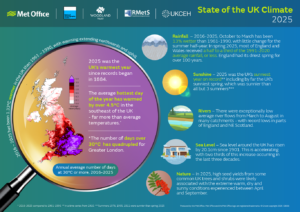
The latest State of the UK Climate report, published on 15th July 2026, confirms 2025 as the UK’s warmest year since records began in 1884, the fourth of the last four years to take that title. The 2016–2025 decade ran 1.33°C above the 1961–1990 average. Greater London now sees more than four times as many 30°C-plus days as it did a few decades back.
Meanwhile winters have become about 13% wetter over the same period, and very wet winter months have roughly doubled. Britain has, in effect, signed up for two extreme climates for the price of one.
The detail that matters is not just that 2025 broke records, but that it did so with La Niña acting as a temporary brake. This year has El Niño instead, stacking further heat on top of the same warming trend. This suggests that last summer’s “unprecedented” temperatures were a preview of the new normal.
The numbers are hotting up
In June 2026, England posted its warmest June on record. The mean temperature was nearly 3°C above the long-term average, with a first-ever three-day Red Warning for extreme heat. High street footfall fell 6.2% year on year that month, while air-conditioned shopping centres slipped a comparatively gentle 2.5% and retail parks barely blinked at 0.3%.
Nobody suddenly decided to stop shopping in June. But when the pavement feels like a pizza oven, the appeal of a leisurely wander around the town centre starts to fade. On the single hottest June day on record, footfall on the high street dropped 13.7%.
Mind the heat gap
Town centres don’t just have to survive the weather once people arrive; they have to survive whatever people went through to get there.
In London, that often means braving the Underground, only 40% of which is air-conditioned. Tube temperatures this summer have been reported as running above the network’s own legal thresholds, with the Victoria line having averaged above 30°C between June and October in recent years.
None of that is a high street’s problem to fix. It’s just a problem the high street inherits. A shopper who’s spent forty minutes in a metal sweat box is not arriving in the mood to browse.
The proof is in the puddles
Heat is only half the story. The other half arrives with the rain.
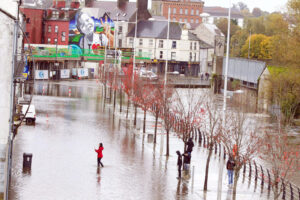
Exhibit A, Newry. In October 2023 the Clanrye River and its adjoining canal overtopped, turning the town centre into a river and putting roughly 80 business premises under water. Some businesses had to smash their own windows to rescue their stock, while others just never re-opened their doors. The Newry Chamber of Commerce described the lack of infrastructure as “catastrophic. And, of course, with climate change, there are going to continue to be events like this.”
Exhibit B, Tenbury Wells, Worcestershire, where repeated flooding got the town council itself dropped by its insurer, Zurich, along with a growing number of local businesses who simply can’t buy cover any more. An insurer walking away from a whole town is a hard thing to argue with.
Can we weatherproof our places?
The solutions are tactics we already know. The difference now is that shade, drainage, and water points have moved from ‘nice to have’ amenities to core public infrastructure.
Start with trees, because the science isn’t in dispute. Research found shaded concrete surfaces run up to 20°C cooler than sun-exposed pavement in summer, with tree shade cutting surface temperature by around 12°C. Which makes the tree the single cheapest piece of cooling infrastructure a town centre can install.
Events need the same forward look. The old planning conundrum of what happens if it rains has been overtaken by what happens if it doesn’t. More summer events may naturally migrate into cooler late afternoon windows, while misting stations, free water refills and additional first aid provision become as routine as crowd barriers and portable toilets. None of these changes are difficult, but they do have implications for event budgets and planning.
The same applies to capital investment. Public realm schemes are designed to last decades, not just survive the launch photos. A space that works beautifully in July 2026 needs to still work on the hottest day of 2046. Whatever “hot” means by then.
Every workplace needs a ceiling
Beyond the infrastructure, there is the small matter of people. And what they are prepared to put up with.
There’s currently no legal maximum temperature for UK workplaces, only a minimum of 16°C, dating from an era when the risk ran the other way. That’s now changing, with a bill to create safe workplace temperatures put before the UK parliament in July 2026. Unions have been pushing for a 30°C ceiling (27°C for strenuous work) for years. Whatever number Parliament eventually lands on, the principle is now mainstream: there is a temperature at which a workplace stops being fit for purpose.
Nobody has yet asked the equivalent question about a high street. If it’s too hot to make someone work in a room, it’s presumably also too hot for them to queue outside a café or wait for a bus.
The US joined these dots a few years ago, with a job title. Miami-Dade appointed the world’s first Chief Heat Officer in 2021; Phoenix and Los Angeles followed within a year. Their brief includes tree planting, cool-surfaced roads and roofs, shade audits, heat warnings pitched at the people least able to escape it. Nothing revolutionary, other than the fact it exists as a permanent function, not a summer news story.
The long-range forecast
The best places have always been built for the future. And since the climate of 1996 isn’t coming back, that means worrying less about the weather we remember and more about the weather we’re actually going to get.
Thirty years ago, town centres adapted to online shopping. More recently, they adapted to hybrid working, and the realisation that people visit places for more than just buying things. The next adjustment is to create a destination that people still want to visit, whatever the weather.
Imagine if the town centre became somewhere people went to escape the heat.