Take a look at photos of the high street in a British town in the 1960s. The odd Austin Cambridge or Morris Minor neatly parked on the kerbside. There was actual space and an abundance of pavement, which meant shop fronts were welcoming and in plain sight. People could see the shops and browse at their leisure.
That same street today is a canyon of metal. Wing mirrors inches apart. Pavements half-blocked by SUVs. A choreography of reversing, waiting and mild road rage just to find a parking place.
In 2026, the car as a stress-free way of getting around has long gone. And the high street is paying the price. Unless we make it genuinely easy for people to get in, park up, be dropped off or arrive on their own terms, the retail renaissance everyone talks about will stay exactly that. Talk. So what is going to move the needle?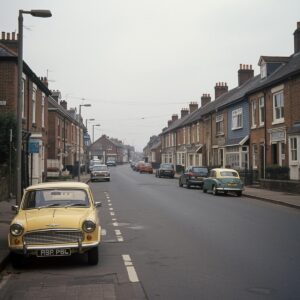
Well, for one, it’s not going to be urban car-sharing. Zipcar, the company that envisaged a revolution in travel for city dwellers in the early 2000s, shut down all UK operations in December 2025. The dream that people would cheerfully give up their cars in favour of a shared fleet never quite materialised. It turns out people are deeply attached to having a car available at the precise moment they want one, and the economics for operators are fearsomely difficult. Zipcar posted losses of £11.7 million in 2024 and the incoming London congestion charge extension to electric vehicles was the final straw.
What is on the horizon is something altogether more radical: fully autonomous, driverless taxis. The Automated Vehicles (AV) Act received Royal Assent on 20th May 2024, establishing the legal framework for self-driving vehicles in Great Britain. Commercial pilots with paying passengers are targeted for Spring 2026, with full framework deployment aimed at the second half of 2027.
This opens the door to the likes of Waymo, Google’s autonomous vehicle spin-out, and to Tesla with its Robotaxi, both eyeing the UK market. Whatever reservations people may have about stepping into a driverless vehicle, the economics of this mode of travel at scale are quiet extraordinary. With falling AI costs and cheap electricity, a robotaxi trip could cost less than 20p per mile, which for most people begins to challenge the default assumption that owning a car is simply what you do.
If autonomous vehicles reach that price point and scale to a point where they are plentiful and can be instantly and reliably booked for any occasion, private car ownership in urban and suburban areas could fall off a cliff. Some more ambitious forecasts suggest that by 2050, the majority of passenger miles in cities could be served by on-demand autonomous fleets.
The more likely picture is a hybrid model: robotaxis for short trips into town, and private cars, still with increasingly sophisticated driverless features, kept for longer journeys and routes where coverage remains thin.
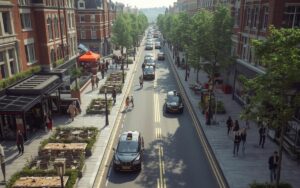
For town centres, the kerbside itself gets reimagined. No more rows of parked cars. Instead, a smart, dynamically managed strip where autonomous vehicles pull in, drop passengers at the door and move on. Deliveries arrive in allocated slots. The pavement widens and the shop fronts become visible once again.
We built our towns around the car for the best part of a century. The next chapter might just be about building them around people again. The technology to do it is closer than most people think.