Let’s start with a hypothetical, because hypotheticals are where we pretend we’re not talking about real things. Is it better to throw a party with a small number of people who genuinely want to be there…or a heaving spectacle full of people who’ve been incentivised to attend?
We’ll call the two options The Parish Hall versus The Russian Oligarch.
The Parish Hall has stackable chairs, fluorescent lighting, and lukewarm squash. It’s attended by the same crowd that comes to every party, the people who know where the bin bags are kept and will stay behind to sweep the floor at the end of the night. It is familiar and connected and everyone has a good time.
The Russian Oligarch party takes place on a rented super yacht, docked somewhere tax-efficient. It’s full of mingling B-list celebrities, professional smilers, and symmetrical faces. There’s an open bar of top-shelf champagne and goody bags filled with iPads. The music is loud, the conversation is superficial, the caviar is fresh. Everyone is told to look like they’re having a good time.
Which is the better party? The Parish Hall, right? Of course it is. What’s not to like about genuine banter and easy laughs among friendly faces. No influencers, no curated angles, no sponsored content.
Now bear with me while I make the argument for the super yacht.
And then, while you’re distracted by the champagne, look over there as I subtly shift the context from parties to towns and cities. Because another way of framing the question is whether we want our places to be busy and artificial or quiet but authentic.
The Parish Hall model is about quality over quantity, depth over breadth. At a private gathering, sparsity is intimacy. But in a city, emptiness is death.
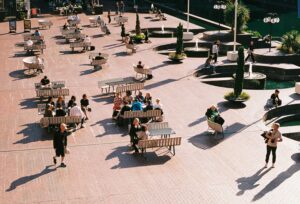 So let’s put forward some arguments for the Russian Oligarch strategy.
- The “Empty Restaurant” syndrome. The most powerful force in urban dynamics is Social Proof. No one wants to be the first person to sit in an empty restaurant. So paying a few people to hover at the window, or street performers to generate vibe is just “priming the pump”. The fake crowd acts as a magnet for the real crowd.
- Eyes on the Street. In the world of placemaking, “loitering” sits uncomfortably next to trespassing in the rogue’s gallery. But according to Jane Jacobs, a populated street is a safer street. Better a plaza full of people eating free sandwiches than an empty plaza waiting for trouble.
- “Dress for the jobs you want, not the jobs you have”. Property developers do this all the time. They buy “cool” by offering free rent to coffee shops, galleries, and other culturally useful businesses on the ground floor of new developments. These subsidised occupants create the culture that jumpstarts the local economy and eventually justifies the higher prices.
The Parish Hall regulars may be the soul of the city, but they are not the pulse. You cannot build an economy on people who bring their own Ribena. You need noise, movement, and the visual impact of “footfall”.
Which introduces the blurry line between footfall and loitering. Traditionally, loitering has been treated as a social ill. A warning sign. A prelude to antisocial behaviour, or worse, bored teenagers. But intentional loitering might be the most valuable thing happening in a town centre.
For a century, our urban centres operated a retail monopoly, engineered as high-velocity corridors to usher you in, extract your cash, and usher you out. Conveyor belts built for throughput, not ‘dwell time’.
Now that the digital world has broken that stranglehold, cities are frantically pivoting, transforming themselves from points of sale into points of experience. Hey kids, come back in, throw an axe, let’s play some shuffleboard.
As our town centres move from marketplace to theme park, they need more than “if you build it they will come”. They need some human wallpaper to jazz the place up, some background extras to turn perception into reality. The party’s not going to throw itself.
Which raises a heretical question: should we consider not only encouraging loitering, but actively subsidising it?

Not in a “pay people to lean on walls” way (though don’t rule it out), but in funding people to stick around in our town centres a bit longer. Because the people who stay longest, even if they don’t buy immediately, are the ones who form habits, relationships, and loyalty to place. They are the ones who come back.
Footfall analytics increasingly back this up. Long dwell times correlate with repeat visits, event attendance, and long-term commercial health. In other words: the loiterers are doing unpaid community-building work. The least we could do is stop moving them on.
And of course, payment doesn’t have to come in the form of cash. Many people would hang around an extra hour or two to avail of a free coffee, free public transport, or a voucher towards books, music and theatre, like those available to young people in European cities.
For these small incentives to work, people need inviting spaces where they can linger without feeling obliged to spend money. Somewhere warm to sit and be, read a book, listen to music, or watch the world go by, seated on nothing more fancy than a simple bench. And if a city feels like it genuinely wants people to be there, buskers might play one more song, baristas pour another latte, and loiterers catch the later bus home.
A little activity can ripple outward. Paid loiterers would be the social scaffolding; once the building is standing and the scaffolding removed, no one remembers it was ever there. Like the laughter track of a sitcom.
The argument here isn’t necessarily that a big fake party is better than a small real party. It’s that a big fake party has a better shot at becoming a big real party than a small real party ever does.
After all, we’re all complicit in some version of fake it ’til you make it. What harm then a few paid loiterers to get the party started as we top up our champagne?